Losing a New World to own and exploit
I was reading news yesterday that Meta is cutting funding to its Virtual Reality Metaverse project. The creation of a new space they controlled and could capitalise on all interactions within.
The dream of building new digital territory to exploit is lost after vast amounts of money (perhaps $77 billion) and new technologies were applied.
Urban Commons and Thresholds
Later, in the evening, due to BlueSky message about an e-book sale, I was skim reading two new books on towns and commons: Towards the City of Thresholds and The Commonist Horizon.
What those books discussed is the difficulty of building commons in tightly controlled, crowded and owned urban spaces. If the metaverse was Facebook seeking to create a new digital space to rent out and monetarise, then what hope is there for people wanting to simply find space in their home towns to build and share commons. If a vastly wealthy corporation fails to make new space, what can people do?
The point made is that we can all create thresholds.
Make gateways to enter newly imagined common places.
The Fold Up table as threshold
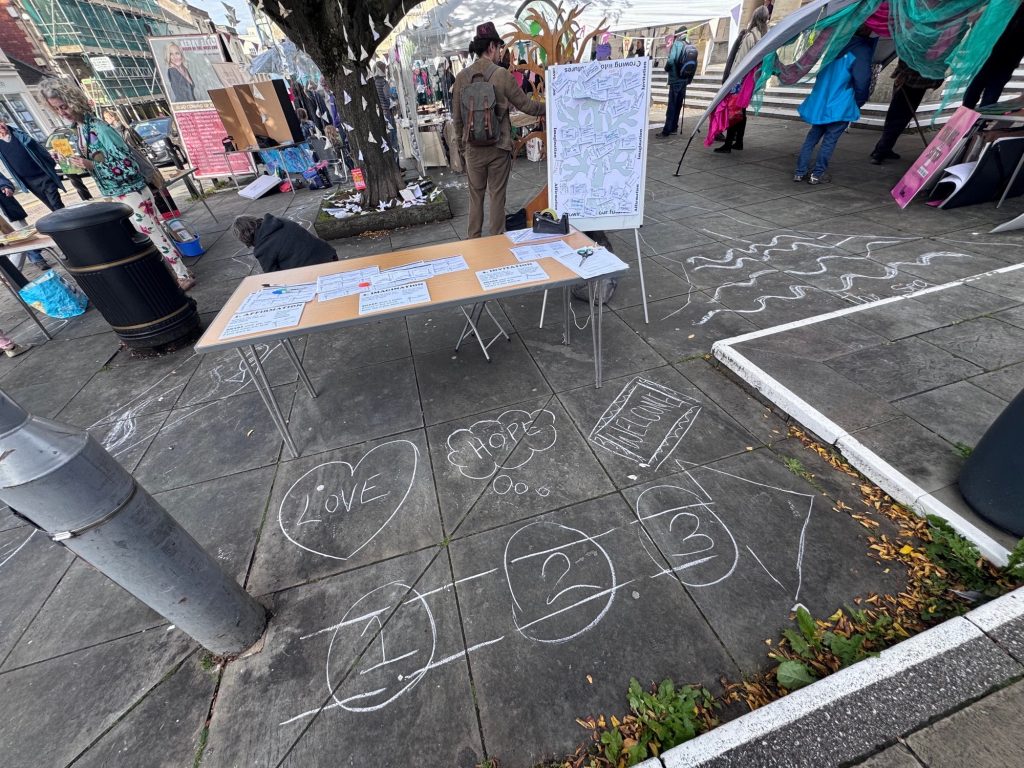
This made me think think of the power of the fold up table. How many people and small organisations use them to make a space to listen, to talk, to teach or to make.
For example, Repair Cafes where old consumer technology is rebuilt by experts sharing their knowledge freely. Make and Mend events where people share and learn skills to sew and knit so clothes can be maintained over many years. All of these forms of Commons that pop up and use fold up tables.
The picture above is of a fold up table I used in an event in Stroud to engage people in imagining what a better future would feel and look like.
The table was a threshold to a new commons.
People can use simple artefacts to make places of new imaginations.
This is like the idea in Rhiannon Firth’s Disaster Anarchy book on community aid and anarchism that there needs to be a rupture for people to see there is an Outside to their established shared reality. There are new places possible that we can cocreate and make together if we are unfooted momentarily to see that possibility.
The fold up table may be technically less complex than VR goggles but maybe it can do much more.
Facebook (Meta as it proudly renamed itself) apparently spent $77 billion on the Metaverse. That would be about 4 billion fold up tables. Imagine the scale of change in that: so many encounters and gatherings to learn, teach, play, talk and listen.