In cultural organisations, we tend to treat the beginning of an initiative as a marketing challenge.
A new exhibition, public programme, co-creation project, or community partnership appears on the horizon and we focus on the invite: the campaign, the poster, the carefully crafted press release.
If the numbers at the door look good, we assume the project has started well.
But for visitors, participants, artists, and community partners, two distinct moments shape whether they truly join and stay: the invitation and the welcome.
- The invitation is how people first hear about what you’re doing and begin imagining themselves in that space.
- The welcome is what they encounter when they arrive: the front-of-house experience, the staff attitudes, the signage, the unspoken rules, and the ways the institution holds both safety and care.
Cultural organisations are often highly skilled at crafting invitations but far less deliberate about designing welcomes. That imbalance decides who turns up once – and who feels able to return, collaborate, or co-create.
This post explores what meaningful invitations look like in a cultural context, why welcomes matter even more, and how thinking in terms of hard and soft boundaries can reshape how people experience your institution.
Invitations: Naming the Destination and the Journey
A cultural “invitation” might be:
- A poster for a new exhibition
- A call for artists or community collaborators
- A programme brochure
- A schools outreach email
- A tweet about a public event
Whatever the format, a good invitation does more than attract attention. It gives people enough truth about what this will be like that they can decide whether to step into your space.
Clarify the Destination in Real Terms
First, people need a clear sense of where this initiative is heading.
Vague promises such as “exploring community”, “rethinking heritage”, or “bringing voices together” are common in cultural language. They sound serious and inclusive, but they often fail to tell people what they are actually being invited into.
For an exhibition or programme, the destination might mean:
- What stories or questions will be at the centre
- Whose perspectives are foregrounded
- What kinds of engagement are genuinely possible (looking, discussing, making, co-creating, decision-making)
Ask yourself:
- Could a local community organiser, artist, or teacher explain this invitation in two simple sentences to someone else?
- Would they know who this is really for and why it might matter to them?
If not, the destination probably isn’t clear enough.
Be Honest About the Journey and Its Friction
Cultural invitations often focus on inspiration and opportunity, but quietly erase friction:
- Time and emotional demands of participating
- Travel, access, and cost (even when entry is free, time off work or caring commitments may not be)
- Potential discomfort in talking about race, class, trauma, or contested histories
- Navigating institutional processes and power dynamics
When we gloss over these, people arrive with one expectation and meet another.
A more honest cultural invitation gently names some of the likely roughness:
- “This programme will involve conversations about loss and injustice that some people may find emotionally demanding.”
- “We’re asking for a regular commitment across several weeks; there is no expectation that you attend every session, but continuity will help.”
- “We’ll be working within the constraints of this building and its current policies; we are committed to adapting where we can, and we will be transparent about where we can’t.”
That kind of invitation does not reduce numbers; it respects people’s capacity and constraints. It allows community partners, educators, artists, and visitors to make decisions that are right for them and their communities.
Respect People’s Agency
Invitations in cultural spaces should avoid moral pressure of the form:
- “If you care about X, you should be here.”
- “This is your chance to have your say – don’t miss it.”
An invitation can:
- Spark a new desire to be part of cultural work.
- Clarify an existing one by offering a clear route to act.
But it cannot and should not override someone’s own judgment about their emotional load, safety, or community responsibilities.
An ethical cultural invitation sounds more like:
“Here is where this project wants to go and the kind of journey it will involve. If that aligns with what you care about and you have the capacity, we’d like to make space for you here.”
Welcomes: How Cultural Organisations Make Boundaries Felt
If invitations are often handled by marketing, welcomes are enacted everywhere else:
- The website and ticketing journey
- The front desk and security team
- Gallery staff, volunteers, educators
- Signage and wayfinding
- Accessibility arrangements
- The way staff respond when something goes wrong
You can have a brilliant invitation campaign, but if someone from a marginalised community arrives and feels watched, doubted, or ignored, the project has already failed for them, regardless of the quality of the programme.
Welcomes as Visible Edges
Think of a welcome as drawing the edges of your institution in a way that people can understand and trust.
Visitors and participants are constantly asking, consciously or not:
- “Is this space for people like me?”
- “What happens if I speak up, ask a question, or challenge something?”
- “Will my children be seen as guests or as risks?”
- “If something feels unsafe, who will listen – and what will they do?”
A deliberate welcome makes those edges visible:
- It explains, in plain language, what is expected and what is protected.
- It shows what behaviour is not acceptable – and what will be done about it.
- It communicates that there is room for uncertainty, emotion, and disagreement, not just polite consumption of culture.
Without these edges, many people will remain on their guard, especially those who have previously been excluded or harmed in cultural spaces.
Hard and Soft Boundaries in Cultural Spaces
Within this framing, it’s helpful to distinguish between hard and soft boundaries.
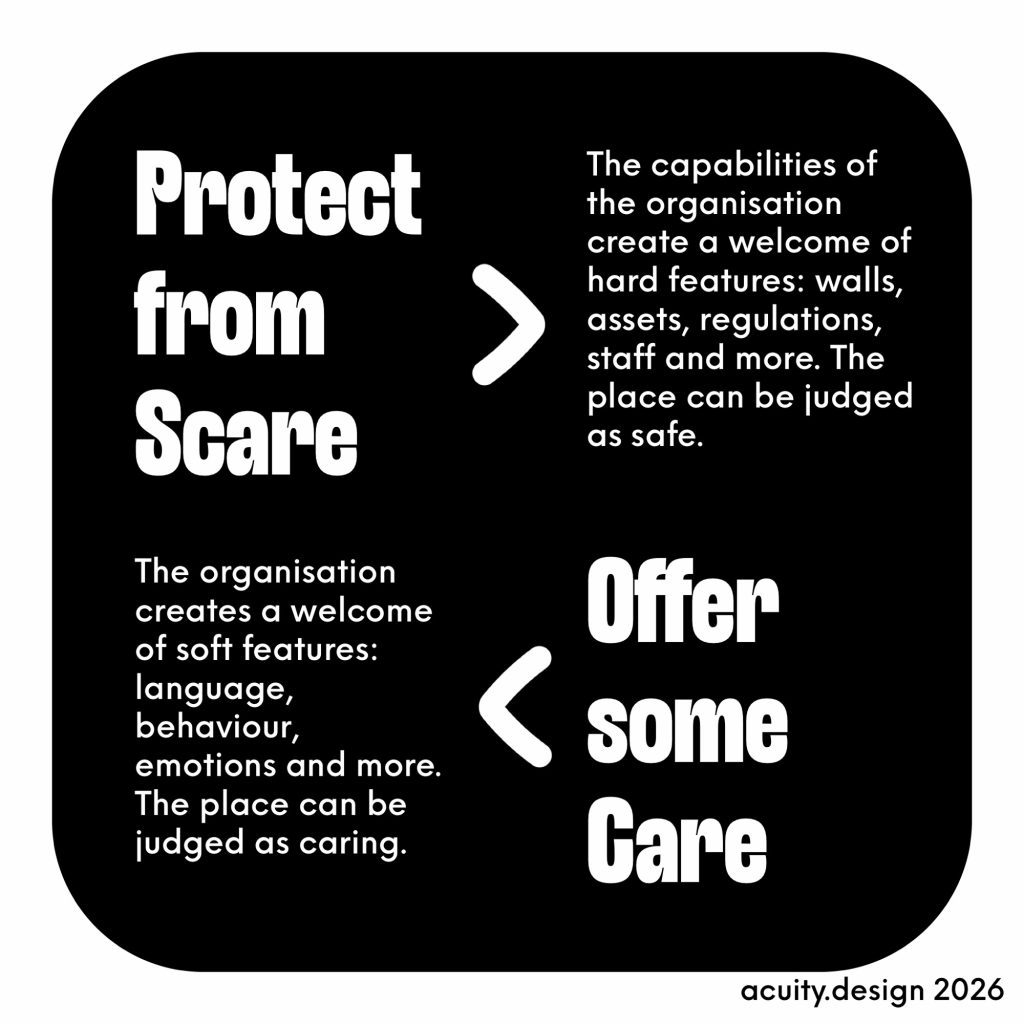
Hard Boundaries: Protecting People From Harm
Cultural institutions typically have a lot of hard boundaries already:
- Safeguarding and child protection policies
- Security procedures and bag checks
- Codes of conduct, complaints procedures
- Legal and insurance frameworks
These are essential. They communicate, at least on paper, how the institution will protect people from certain kinds of harm.
However, hard boundaries alone often feel like the organisation protecting itself – its collection, its reputation, its liability – rather than primarily protecting visitors, staff, and communities.
Soft Boundaries: Caring For People In the Space
Soft boundaries are about how people are actually held and cared for once they cross the threshold:
- Do staff know how to host difficult conversations without shutting them down?
- Is there a clear, kind response when someone is distressed in a gallery?
- Are there routes for people to say, “This story, object, or display harms me,” that go somewhere real?
- Are there visible practices that show you understand emotional access, not just physical access?
These soft boundaries are rarely written into glossy policies. They live in training, everyday habits, and the tacit culture of the organisation.
People Read Both at Once
Visitors, artists, and community partners are reading both sets of boundaries simultaneously:
- “Will I be safe here?” – not only physically, but emotionally and culturally.
- “Will I be cared for here if something is difficult?”
Many institutions have invested heavily in hard boundaries and almost nothing in soft ones. A deliberately designed welcome in a cultural setting means making both sides visible and coherent.
Organisational History: The Ghost in Every Invitation
Cultural organisations rarely start from a blank slate.
People bring with them:
- Past experiences of being unheard or misrepresented
- Stories of who usually gets to decide what is shown and how
- Memories of security guards following them, staff talking over them, or tickets being priced out of reach
- Public controversies about whose heritage has been centred and whose has been sidelined
This history travels silently with every new project. It shapes whether invitations are trusted and whether welcomes feel believable.
Locate the Project in Your Real Story
When you launch a new programme, ask:
- How does this sit within our actual history, not just our aspirational values?
- Are we implicitly relying on people to forget past harms or exclusions?
If you are genuinely trying to do something differently – opening collections, sharing power, centring new voices – you need to name that change explicitly:
- “Historically, we have not made enough space for X. This project is one of the ways we are changing that, and here is how you will see that change in practice.”
- “We know that some communities have felt unsafe or unwelcome here. We are working with them to redesign how we welcome and support visitors.”
Without this honesty, new invitations simply sit inside old boundaries.
Towards Trustworthy Cultural Welcomes
For cultural organisations, designing better invitations is not just a marketing exercise; it is part of a wider ethics of hospitality and power.
To move towards more trustworthy cultural welcomes, we can:
- Write invitations that clearly describe the destination and acknowledge the real journey, including emotional and practical friction.
- Respect people’s agency, allowing them to judge their own capacity and safety, rather than nudging or shaming them into attendance.
- Design welcomes that make boundaries visible: who is protected, how care is offered, and what happens when things go wrong.
- Invest in soft boundaries – training, practices, and roles that hold people emotionally and relationally, not just procedurally.
- Face institutional history honestly, so that new commitments to welcome and inclusion are credible.
Ultimately, the question for cultural organisations is not only, “Can we persuade people to come?” but:
“When they cross our threshold, will they feel that this space understands what it means to care for them – not just as visitors, but as whole people, with histories, vulnerabilities, and agency of their own?”.
That is the work of invitations and welcomes worth doing.