Guy Deutscher’s book The Unfolding of Language talks about how, over time, humans streamline their languages. Words are blurred and shortened. Grammar compacts and lose rules. Humans want to communicate but they also want to do it more efficiently and more lazily.
This linguistic ‘degradation’ has led to centuries of complaints about the failure of modern generations and the lost heights of past human civilisations. It is however, natural. People seek energy and time-saving for deeply mixed reasons.
Lazy Efficiency
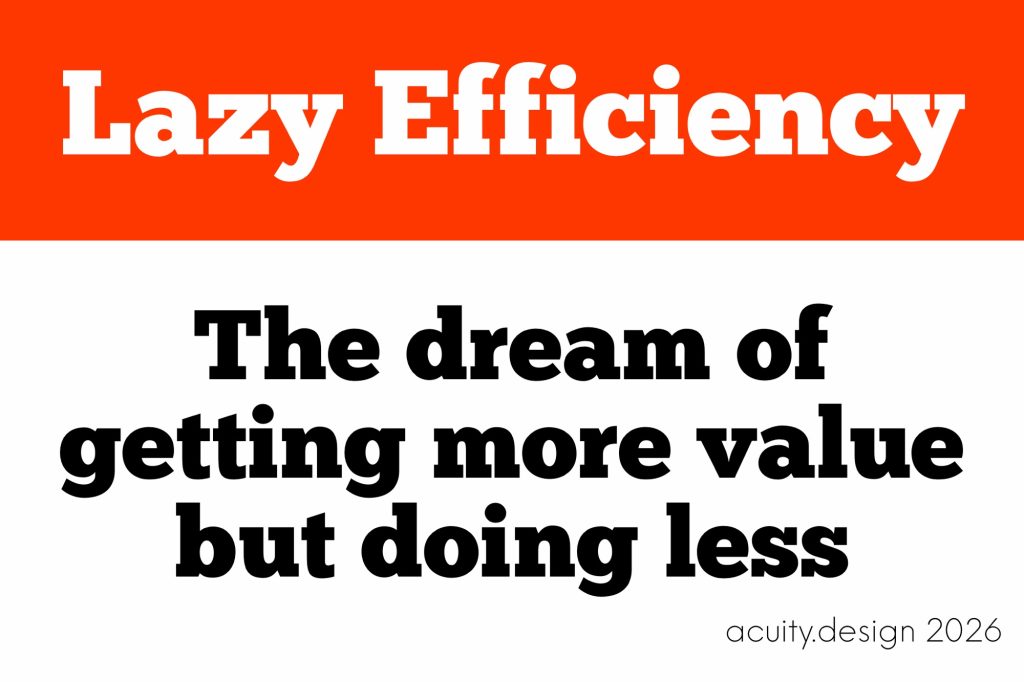
That loop of lazy efficiency is perhaps also at the heart of the current AI bubble.
People are attracted by the hope of technical efficiency and the comfort of laziness. The Cognitive Surrender and the Corporate Value linked together because humans can want more by doing less.
This is, like the language streamlining, natural and turns up, more deeply, in human evolution. The size of the human brain is often highlighted as showing why humans have become so dominant. Yet it is that big brain that is also a problem for the body. It uses a lot of energy. So, as an ongoing process, the brain is shrinking. The evolutionary pathway is to reduce the energy demand and increase body efficiency. In an embodied sense, the brain is a decadent energy hog.
What’s going on in new research?
There are a couple of research papers that seem helpful on this moment.
Thinking—Fast, Slow, and Artificial: How AI is Reshaping Human Reasoning and the Rise of Cognitive Surrender on the sense of cognitive abandonment or laziness of people. Thanks to Esko Reinikainen for pointing it out.
The Memory Paradox: Why Our Brains Need Knowledge in an Age of AI is helpful on the need for information and interaction friction for memory and learning systems to engage. That the AI efficiency betrays the users.
In both papers, it is noted that these are preliminary learnings of emergent situations. They are warning about future pathways that risk individual cognitive capacities and social connections.
AI is not inevitable. No technology is.
The spiral
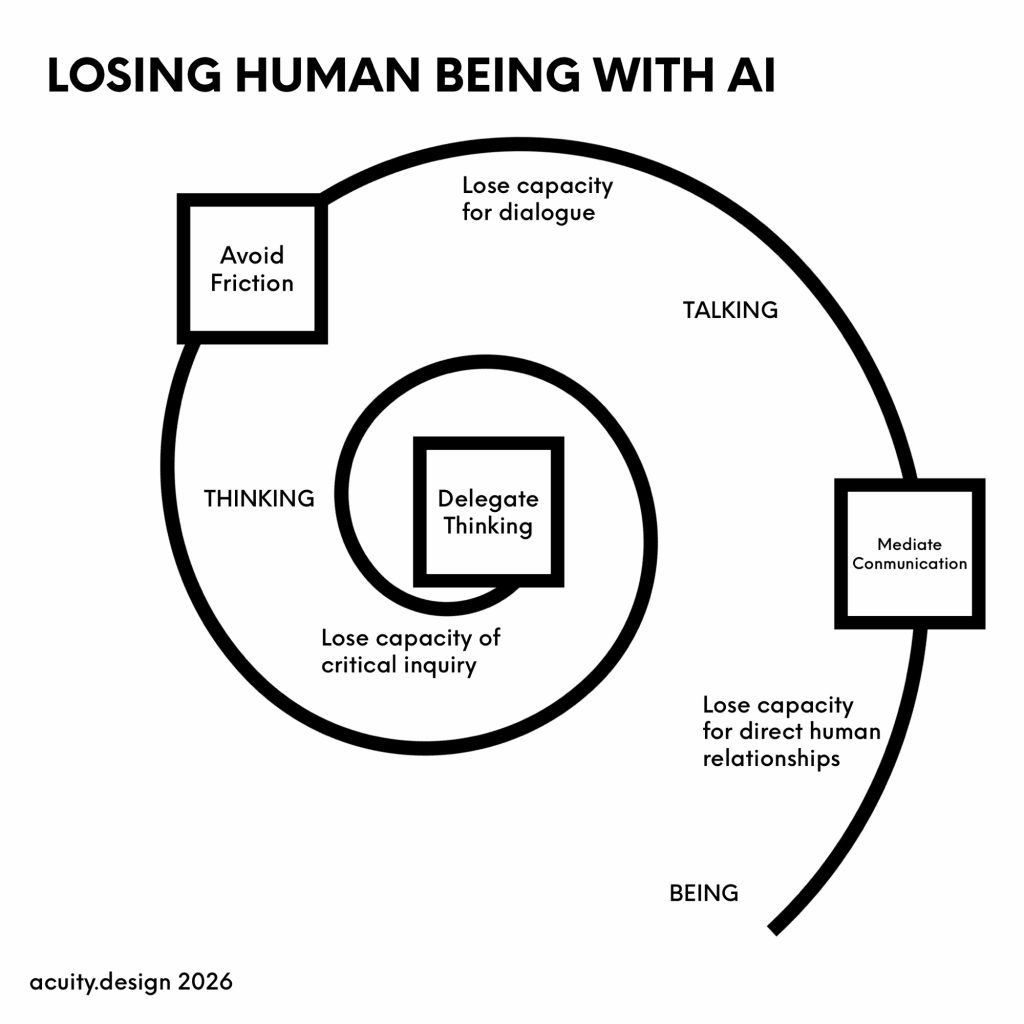
The spiral diagram above comes from conversations I had with a ChatGPT model trained on some research in facilitation methods and tools. It is the most negative pathway offered by the AI.
- Delegate thinking
- Avoid friction
- Mediate communication
Currently the Delegation problem seems to be of most concern in the media. The Lazy Efficiency problem of organisations seeking value by employing fewer humans while also humans seek to do less by employing AI prompts.
Friction matters
Avoiding friction is both a smoothing of interaction and a widening of a gap between people.
The digital design dream of service design that is so easy and so clear that a person achieves their intent in moments without having to engage in detail or use too much cognitive effort.
The culture war anxiety that any conversation risks becoming toxic and painful and thus it is easier to not have that interaction. This was explored, in 2016, in Sherry Turkle’s Reclaiming Conversation.
Yet, as the research paper above discusses, it is friction that activates and engages the memory and cognition systems. The friction is the pain that humans need: like the controlled tearing of muscles in exercise that then knit together as stronger, fitter muscles.
Being together
The final point about fully mediated communication reminds me of EM Forster’s short story The Machine Stops. It is part of this collection on Project Gutenberg The Eternal Moment. In that story, humanity ends up so individualised and mediated thru the Machine that being together is viewed as painful, if not perverted.
Human being is a social community not an individual consumer.
The Being I worry for is the community we lose. The Lazy Efficiency we are attracted to could drag us into that dystopian solipsism where our intolerance of thinking and of friction leads to a fully enabled solitude.
The machine talks for us and the machine talks to us because we find us too anxiety-inducing.
This is not inevitable
The Industrial Revolution had machines that were more powerful than humans, that could work longer and faster than any individual. Yet, it did not make humans irrelevant as people came together in community organisations like unions and political parties.
Sometimes the Lazy Efficiency does encounter a wall. It is a pathway, it is attractive but it is not inevitable.
The first point is to recognise that attractiveness of Lazy Efficiency and discuss it openly.
The second point is to make the effort to talk to other people and organise alterantives.