Unsee’ing came up at CampDigital yesterday while taking about walking around places like an alien, perception and human-centred design.
Perception seeks usability – we sense and remember what is useful to our purposes and intents. This means we unsee what is there but not useful to us. We do not perceive what is useful to other people. We blank out places and people.
- A High Street can be empty but full of shops.
- A person can feel lonely in a place full of people.
Unsee’ing is a phrase from China Mieville’s The City and The City. A practice in a imaginary place where two communities live in the same place but are socialised to not notice the other community. They are taught to unsee the architecture, clothing, posters, language of the Other.
To see the Other is called Breach and I think about that as a concept a lot lately. The anxiety of people and organisations at deliberately shifting perspective and perception.
Not empathy, but seeing
Seeing can be done thru increasing the diversity of a team’s membership, thru codesign and participatory user research techniques.
Unsee’ing is like GroupThink.
It is a bias based in the natural growth of people in a culture where the boundaries of familiarity become the walls against noticing alternatives ways of being and actual neighbours.
In anarchist and mutual aid books, there is a point made that sometime you need a disruption to see alternatives. A break in ‘Normal Service’ that enables an Outside to become visible to people who live within the familiar ways of doing and being.
Unsee’ing is something I would prefer to break. It is possible to do with any group. However, approaching that moment of rupture and making the tear explicit is something that people and organisations find anxiety-inducing. There is comfort in not noticing and that is natural for people but something, perhaps, we need to consider how to hold and do better at organisational and system level.
Breach
This is something I am working on for another project.
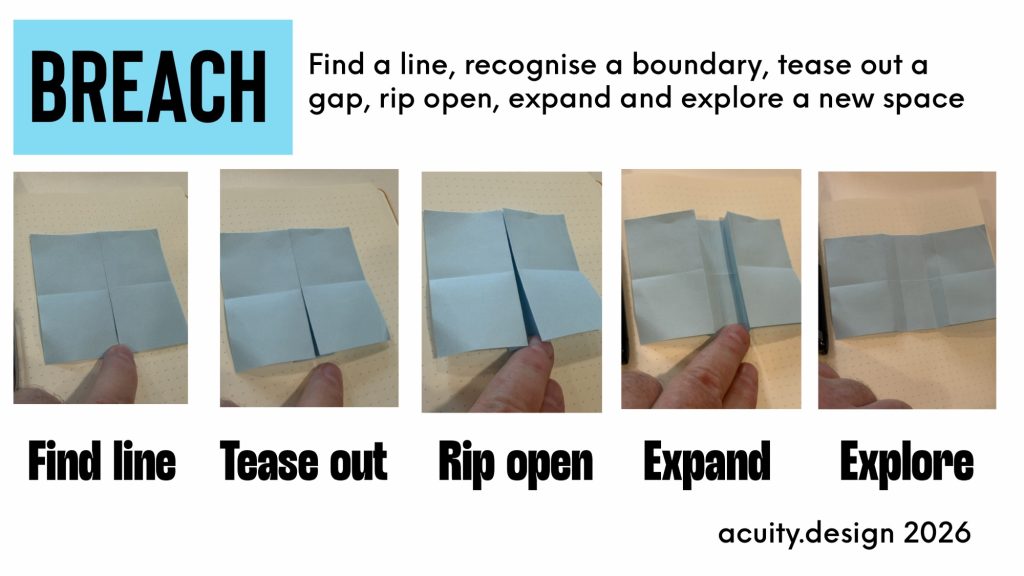
The sequencing of Breach for a group to explore a new space. Making new spaces is easy in digital – how to do that deliberately with people is hard. This is change management as placemaking.
- Find line
- Tease out
- Rip open
- Expand
- Explore
Noticing there is a line or a boundary, is the first step of seeing. Many people avert their senses and move on.
Teasing out and ripping open the line is what organisations fear. The unknowable and the uncontrollable happening what stability and management are what they prefer.
This is the part I am looking at most. How to reassure people, both as individuals and role-holders in organisations, that this is necessary and good.
Happy to chat with anyone who is interested in these ideas.