Audio version: Finding the right words
When I was doing some work for the UK’s Design Council on their Systemic Design Thinking toolkit for the Climate Crisis, I ran several workshops with differing audiences. I discovered that the language within the toolkit, which was supposed to be neutral and professional, caused issues. When I used certain words with climate change activists, they landed badly compared to the way that the same language was heard by audiences of professional designers.
It was this experience of the way that you can lose an audience, or you can lose participation of a team that led me to create a tool to use at the beginning of project kick-off meetings. What I discovered was that was that many projects go wrong much later, because the language that was assumed to be clear and obvious to all, was never checked for whether it caused confusion or actual dislike.
I have used this tool with teams in higher education, corporate projects and local communities. It has been helpful because it makes explicit ideas that remain dangerously quiet and implicit until it is too late.
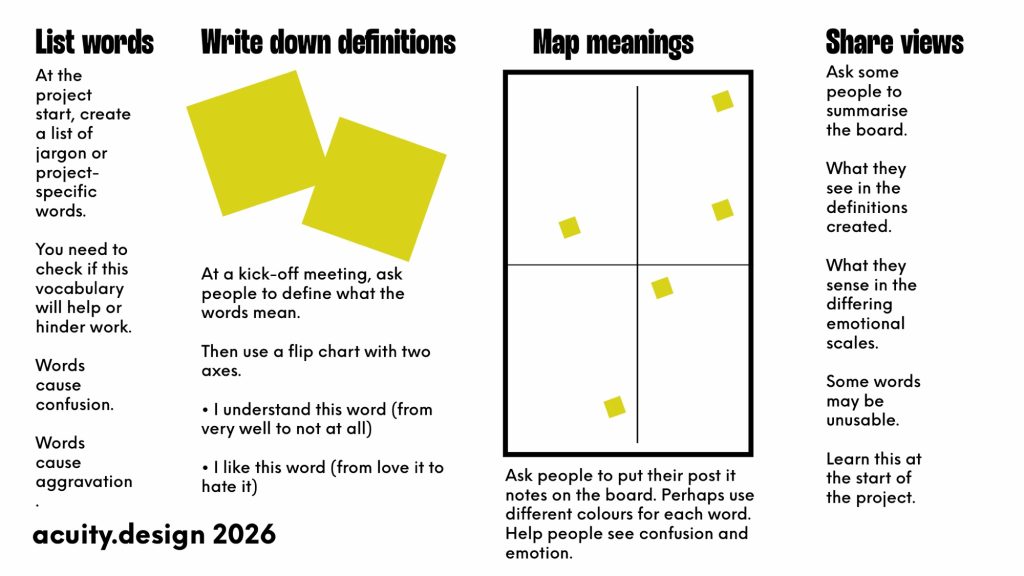
This tool is relatively simple. All you need is some post it notes and a large piece of paper. How you use it is summarised in the diagram above, but I’ll explain in more detail in the text below.
List the words
When you start a project, you will have many words which have probably been developed during the planning stages. This will include words from strategic plans. This will include words from user research or marketing survey investigations. These words have been developed as a form of jargon to communicate clearly concepts and new ideas very quickly between people who are aware of what they think the meaning were or were there at the point in time when that definition, within that context, was created. These are words which compact many ideas, many feelings and many possibilities. Then they are presented to new team members or to a different professional team as though they are obvious to all.
You need to look at the words at the start of a project to make sure they don’t create problems later in the project. Words can be like grenades. Mishandled they go off, and you are standing in the midst of confusion, aggravation and pain.
Write down definitions
When you run this exercise, ask people to write down their definitions of the words listed.
It’s best if they use a different colour Post It note for each of the words, simply because that creates some form of uniformity when they’re put on the paper later.
Ask them to define the word from their own sense of what they think it means. You need to find out how people think the words operate. Users make meanings, not designers. You don’t control the meaning. Whoever authorised the project or researched the project purpose earlier doesn’t control meaning. It’s held by the people who now do the work. So therefore, you need to discover what they think the word means, and we need to discover what it means to them individually.
Map meanings
Once they have written down the words and the meanings that they define, it’s time to put the words onto the sheet paper.
What you need to use is a large piece of paper, like a flip chart. Draw two lines on it for two axes. What you’re trying to get is the idea of being able to define how people feel about their certainty of understanding a word and their feeling about whether they like the word, this is about how they think about information in terms of its clarity, and its emotion.
One axis has ‘I understand this word’ and runs from ‘not at all’ to ‘very well’. Allow people to show you their certainty or their uncertainty. Allow them to show you their knowledge and confusion.
The other axis, which is ‘I like this word’, from ’hate it’ to ‘love it’. This is to show whether the word is usable in emotional terms. This is the problem which I had during the Design Council work. There were words like ‘ecology’, which were entirely unusable amongst professional people, but loved by activists. If you have words like that in a new project, you will find there are going to be individuals or whole teams who are unwilling or unable to work because the language itself is unusable by them.
Let people spend their time mapping meanings. They put the Post It notes on the paper. Participants can use the paper to be able to understand how they individually feel about words, while slowly beginning to see how all the other people, in the group or the community, feel about the same words. This is one way of revealing how Group Think (or not) operates within a team.
Share views
Once all the words are up, once all the definitions are up, it’s time to use people in the room to discover and explore what meanings are there. So, ask a few people to just look at the board and between them, find some ideas that they see. Let them summarise it. Don’t try and summarise it yourself.
What they may see is differing definitions, many people being very certain they understand a word, but defining it completely different.
Perhaps they will see a complete lack of definitions, a complete uncertainty about what the words which was so clear to the people who did the research or who created the strategy knew but people now don’t understand.
They will discover that there are words which people use but really, really don’t like. Many pieces of jargon are not liked by people, particularly when they transfer from one profession to another. There are words which can be unusable because they are so disliked.
This summary process, with its sharing of ideas and spotting of patterns matters, because this is the way you adapt at the start and prevent problems later in the project. You need to be able to find a foundation of vocabulary that is usable by all members, from all the teams, at the start. If there are words that are creating confusion or emotional difficulties, they need to be understood now before they poison the whole project.
This is a process to be performed relatively quickly at the start of a project to enable you and a team to find a way of working together better. It is one method I use when facilitating project kicks-offs in corporations and communities. I am happy to chat about what your organisation may need too.
One comment: