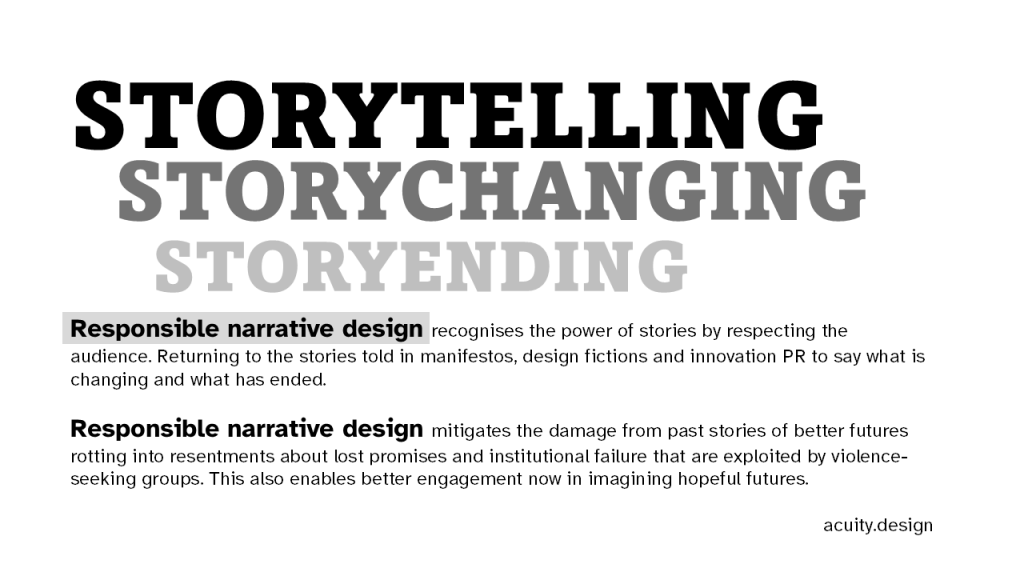
I wrote about StoryEnding lately.
The problem of past manifesto promises or innovative design fictions damaging the present and future. The need to take responsibility for the stories we tell but then abandon.
I was talking to a client this week about this. They are running a 10 year programme around climate change and new technologies. They want to engage better with communities, especially excluded ones, to inform and involve them.
Given the length of the project and the feedback from some civic assemblies that we had previously co-faciltiated, it seemed a good time to talk about storytelling as a repeated process over time.
Responsible Narrative Design
What this discussion led to was the idea of embedding skills and practices for Responsible Narrative Design.
Not merely developing better content creation and storytelling skills but thinking about how to change the story over time and end stories that the projects could not sustain in their product delivery.
Telling stories but also tending to stories as contexts and facts change. Keeping people involved in the evolution of the story and making them aware of when hopeful promises will not be fulfilled.
Stories rotting into resentments
All of this work is to mitigate or prevent the damage of stories that are left to rot by organisations. The hopes, the dreams and the energy of those stories does not go away when the organisation abandons them. They are remembered by the audiences. Sometimes treasured. Sometimes simply noted.
It is these rotting stories that are the mulch for far-right politicians and media owners seeking to turn regrets into resentments and resentments into violence.
That the present is not what was promised by politicians and organisations in the stories told in the past is a problem. This is irresponsible narrative design.
The pain made in the present is also a barrier to creating hope in the future. Why trust or believe in better futures when the present is missing what was promised in the past?
Stories of hopeful future and innovative changes that are never adapted or ended become the fuel for violence that is focussed and exploited today.
Responsible narrative design is trying to prevent that rot happening and that fuel being created.
Stories as Weedkiller
Storytelling is popular idea in corporate content design. It is recognised as powerful and effective. Yet that power and effect is only visible in the present: the new story today.
What this makes me think of is Weedkiller.
Weedkiller had been used everywhere for decades because it is both powerful and convenient. You spray it on the path and weeds die the next day. You keep spraying in the same way and that death remains effectively and conveniently true. The Weedkiller maintains the control that you first desired from your perspective.
Yet, we know, that the use of Weedkiller builds up consequences and systemic damage. The spraying kills the weeds we see but also the plants that are appreciated by other people or are the food for insects that we rely on in the broader food chain.
Stories are Weedkiller when we use them because they are powerful and convenient but we don’t care about consequences.
Tending to stories
Responsible narrative design is weeding. A practice over time of paying attention to the place and the context and removing what is bad.
Recognising that places and communities change. That stories and projects change.
Changing a story and telling it again to an audience so they can shift their expectations.
Ending a story and explaining to an audience why. Preventing hope turning into regret and regret being transformed into resentful violence.
Let me know if you’re interested in these ideas and developing them further.