
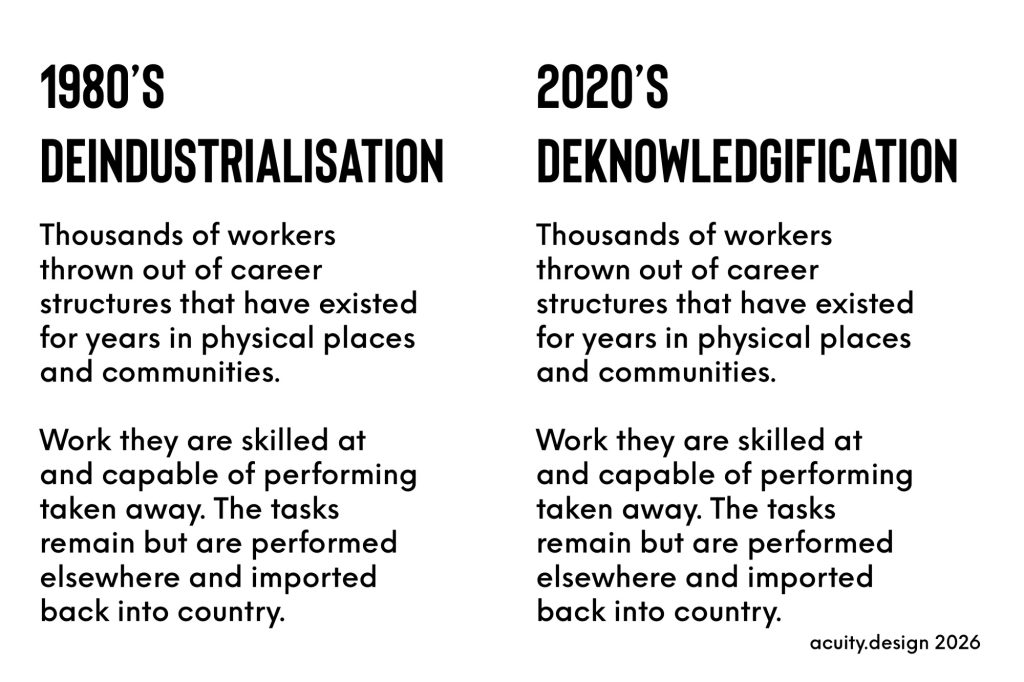
The mass job losses in academia and digital industries now remind me of the 1980’s.
How well-established communities of skill and capability disappeared under something justified as economic systemic change. The loss of jobs that seemed beyond control, beyond people and beyond comprehension.
The market demanded the change and so it happened.
Back home

I was back in Wolverhampton yesterday and remembered both the collapse of the city in the 1980’s with Deindustrialisation and its recovery with the Knowledge Economy and university expansion in the 1990’s and 2000’s.
Now I presume that recovery will be lost and the city will suffer again. The manufacturing jobs were offshored and now the knowledge economy jobs go too.
Another wave of loss
Deknowledgification has the same sense of pain. The people losing jobs are skilled. They have made careers based on proving their capabilities. Yet the work is taken from them. Not because the work ceases to exist but it is now done by people somewhere else.
The corporations say now that it’s automation and AI yet, after a while, you discover that it’s most often old-fashioned exploitation and underpaid human staff in South Asia/Africa/Central America.
As with 1980’s Deindustrialisation, there will be economists and journalists who fill in narratives of the inevitability of Deknowledgification. That it’s global systems in action. That it’s about an imbalance in wage rates. That it’s about humans failing and increasing machine superiority.
Yet it’s mostly about a choice made by corporations today to cut expenses and spend on technology (real and fake). The accounting and tax rules make people a cost and machines a tax-efficient investment and so people lose their jobs and profits go up.
What’s next?
In the UK, there is also the same political lacuna about what comes next.
Thatcher left communities to hang as the Free Market would correct out the losses. Yet clarity only came later when universities expanded with government support and the knowledge economy grew.
What does come next?
After Deindustrialisation.
After Deknowledgification.
It’s a question for communities and for politicians. It cannot be left to corporations and accountancy rules. It’s a question that needs asking now.