I’m just back from Stroud Valley’s Woodcraft Folk annual camp. It was very hot this weekend and lots of young families with kids were there. All worked out well.
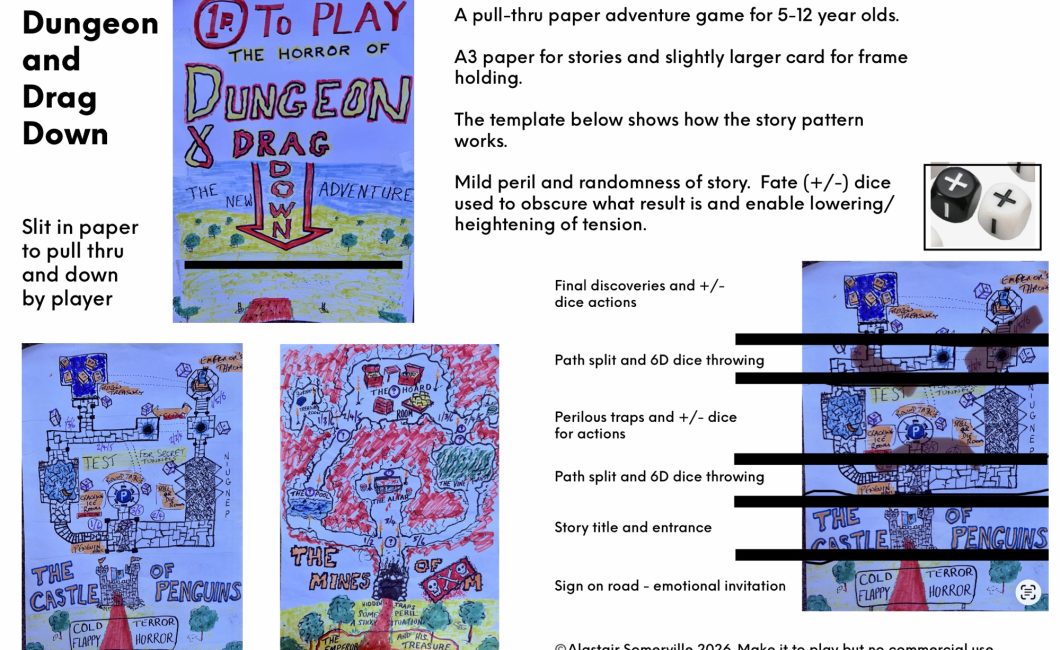
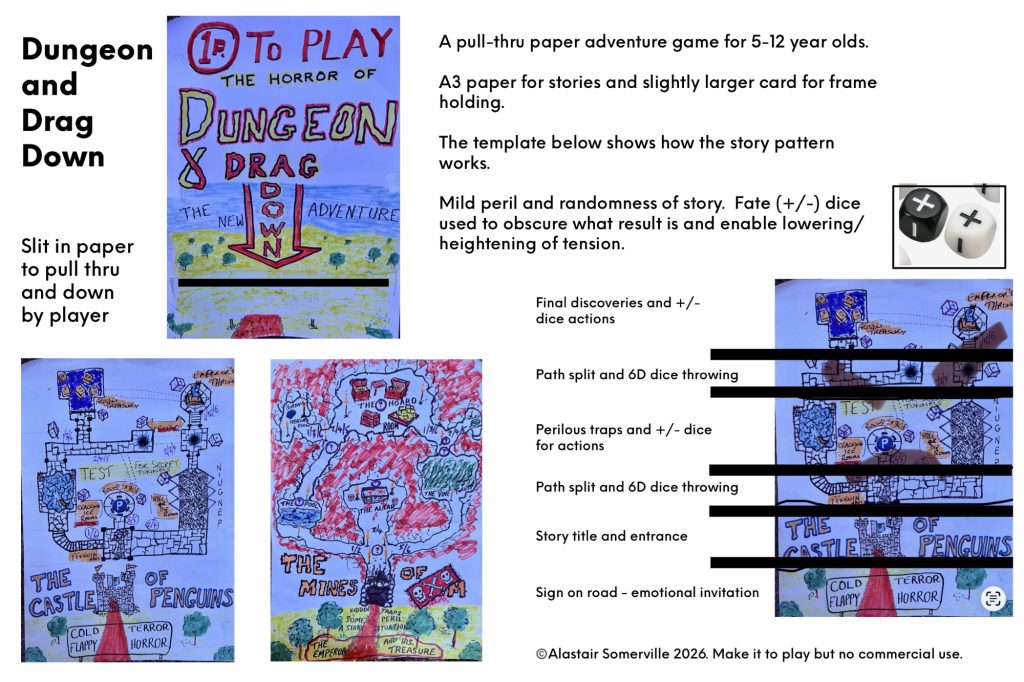
One thing I do every year is make a new game to play at the afternoon community fair (the Pea Fair where the chickpea is currency). It has to be made with whatever art scrap we have brought along. This year it’s Dungeon and Drag Down. A fantasy ‘choose your own adventure’ game that mostly attracted 5 to 12 year olds.
It’s designed as a form of guided storytelling with bounded randomness.
I’ve spent a lot of camps making these games and interacting with kids. It’s interesting to see what works. This year, kids came back to play (I was supposed to do 2 hours but did 3 as kids kept returning) as they recognise that there are different story paths (as many learnt by just sitting and listening as their friends played) but wonder if there is a ‘best’ path. This is the kind of discussion in The Score book – some people play to Win but also many play to Play. The end point and the process matter in different ways. The tension of the ‘right’ victory and the anxiety of playing are things I try to defuse during the game. It’s a story told with some moments of agency and adjustment. The use of Fate (+/-) dice is a way of balancing moments of play where hard numeric values would not help.
The game worked this year. Last year’s Eurovision-style game have had too many decision points and kids lost the sense of a playful flow.
This isn’t a serious business post. More that play is something good to do and practice enables thinking about purpose in design.