This is a rough guide to the facilitation workshop we’re planning before the assembly. It is for anyone wanting to volunteer and be at tables or just in the room on the day.
This is just few ideas and techniques that I’ve used in other assemblies and with other volunteers.
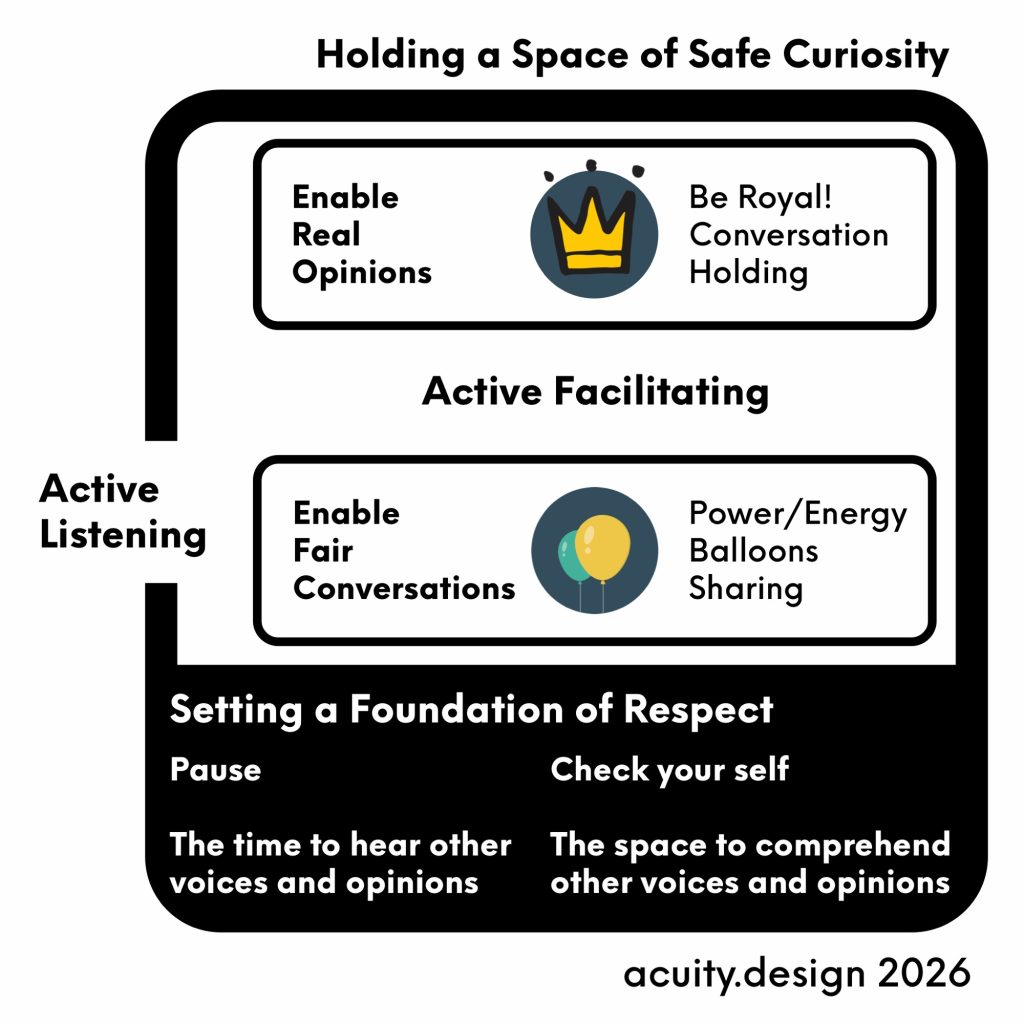
Active listening
Active listening is the core part of any facilitated meeting or event.
It is both structural and personal.
We need to talk about three elements.
Holding a space of safe curiosity
We need to plan an event that allows people to feel safe to be curious.
This is both in planning the setup of the hall but also in how we pre-brief participants in the invitation and welcome materials.
We use systems and planning to build confidence and reduce anxiety.
We need to talk about how we prepare for the event.
Setting a Foundation of Respect
With that boundary of a time/space, we can then help create spaces to be heard and to be understood.
This is the foundation and it is for facilitators to model good behaviours that other people can follow. How we respect people is how people respect each other.
There are two parts here: Pause and Check Your Self.
This is about self-control and preparing for an event where your opinions are not the whole point. This is strongly true for facilitators and partially true for participants.
Pausing to hear
At the most basic level, shutting up matters. It’s impossible to hear if you talk all the time. Modelling silent appreciation is a start for everyone.
Checking your self
Many people listen to reply. The silence is only because they are preparing their answer. This is natural but in active listening, there needs to be a gap.
Listening to comprehend means preparing a space inside yourself to hold the new ideas of the people you meet.
This is hard. It is another form of pause. A holding back. A gap.
Practicing this in the facilitation workshop is less useful than holding the awareness over conversations you have afterwards and before the event.
Active facilitating
The facilitation skills for the event are what we will practice in the workshop. There are two ideas we will look at.
Firstly, fairness. People need to have a communal sense that what they say is being heard equitably. That a quiet person speaking out will be respected as much as a loud person. That the person who is not from a background of power or with a set of presentation skills will be heard and understood equally.
Secondly, opinions. The point of the event is to use a range of people, with different backgrounds and perspectives, to make decisions founded in their opinions. This can be hard tho when people are generally not listened to. Drawing out opinions and ensuring they are rooted in the person’s experiences or learning is important.
Power/Energy Balloons Sharing
This is an exercise about making power and energy imbalances explicit so that they can be facilitated.
How do we move power and energy between participants? How do we look out for the people who feel they cannot speak up and transfer the energy to them from the people who just won’t shut up?
This is about learning to intervene and shift conversations to different people. This is about the most strongly interventional that I would recommend people try and that’s why practice is good.
This will be the main workshop exercise. We will do some role play so as to watch and intervene.
Real opinions
This is about learning some phrases and ways of being present that help a person keep talking and build trust in their own opinions.
This is a shorter practice as it is mostly about understanding how to draw a person out.
We will use a ‘Be Royal’ method. This is based around some phrase that Queen Elizabeth II used to chat with the many, many people she encountered. As Queen, she was not allowed to have clear public opinions so her conversational tricks were to draw more out of people.
I will share some cards and we can do a quick exercise to feel how they sound.
Do less to enable more
A lot of this is about being self-aware enough to shut up.
Do less so people can do more.
The hard parts are held either by planning and pre-briefing or in learning to watch and intervene carefully.
The first we can talk about. The second we can practice.